
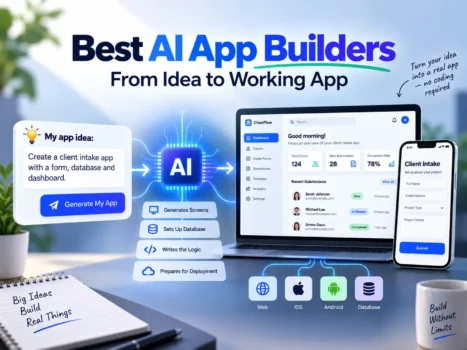
If you have an app idea but no coding background, you don’t need to hire a developer to find out if it works. AI app builders now let you describe an app in plain English and get a working iOS, Android, or web version back in minutes. This style of building is often called “vibe coding,” since you describe the outcome and let the AI handle the implementation.
What Is an AI App Builder?
An AI app builder is a platform that turns a written description of your idea into a working app, generating the screens, logic, and sometimes backend code for you instead of requiring manual assembly. Some only output a web app, others build a native iOS or Android app, and a couple do all three from one project, which is worth checking before you compare anything else.
How We Evaluated These Tools
- How fast a tool gets a non-technical founder from a plain-English idea to a working app
- What actually happens to the bill once you go past the free tier
- Whether the tool hands you portable code or locks you into its platform
- How real users rate the tool on G2 and Capterra, once enough reviews exist to mean something
These rankings come from each tool’s own pricing and documentation pages, plus current G2 and Capterra review data, cross-checked against independent user reports where a pricing page leaves gaps. We didn’t build one shared project across all eight tools, so treat platform-specific quirks like code cleanup or per-fix credit charges as documented by users, not something we tested hands-on ourselves.
We checked every price against each tool’s own pricing page, cross-referencing Lovable and Softr against multiple independent sources as an extra check. All eight figures matched as of this review, though plans change often, so confirm the current number before you buy. G2 scores are our own editorial rating, weighted down wherever the review count is thin (Adalo has 7 reviews, FlutterFlow 30).
Compare All 8 AI App Builders at a Glance


OnSpace AI 3-in-1 Platform
Softr Most Reviewed
The right pick depends less on price and more on what “done” looks like for your idea. A sellable web product, a full-stack app with a real backend, an internal tool built on data you already have, and a native app you’ll eventually hand to a developer each point to a different tool above.
Lovable

Lovable builds full web apps from a plain-English description, then hands you editable, readable code rather than a black box you’re locked into. Exploding Topics ranks it 12th on its AI startups list, citing 1,825% growth over the past two years.
The catch is cost control. Credits get consumed per prompt and per fix, and a founder who iterates heavily can burn through the $25/month, 100-credit Pro plan faster than expected. Pricing runs from a free plan (30 credits/month) through Pro at $25/month and Business at $50/month, both scaling well beyond $1,000/month at the highest credit tiers.
Bolt.new
Bolt.new, built by StackBlitz, runs entirely in the browser and generates a full-stack app, not just a frontend, from a single prompt, with a live preview updating as it builds. That makes it one of the more capable vibe-coding tools when your idea needs real backend logic and a database, not just screens.
The free plan holds up in practice: 1 million tokens a month with a 300K daily cap. Pro is $25/month for 10 million tokens with no daily limit, and unused tokens roll over to the next month, a founder-friendly detail most credit-based tools don’t offer.
OnSpace AI

OnSpace AI generates iOS, Android, and web versions of the same app from a single prompt, the broadest platform coverage of the eight tools here. A free plan now covers roughly 2,000 credits a month on public projects, and the $25/month Pro tier adds 7,500 credits plus private projects and custom domains.
Some users mention credit usage that’s hard to predict, since it’s not always clear which action triggers a charge. It’s also new enough that G2 and Capterra don’t have enough reviews yet to say much either way.
Softr
Softr turns data you already have in Airtable, Google Sheets, or its own database into a client portal, directory, or marketplace, the fastest route for a founder whose “app idea” is really a structured-data problem. Its free plan runs a real app indefinitely, with limits that vary by data source, so check the current caps before you build on it.
The tradeoff is flexibility. If your idea needs custom logic that doesn’t map to records and fields, Softr will feel restrictive fast. Pricing runs from free through Basic at $59/month, Professional at $167/month, and Business at $323/month.
Glide
Glide turns a spreadsheet into a usable app layout in minutes, the fastest idea-to-prototype path on this list. The free plan includes 10 projects and 2 team members, enough to test several ideas before paying anything.
Where it struggles is depth. Once an idea proves itself, most founders outgrow Glide’s spreadsheet-first model. Pricing starts free, then Basic at $25/month, Plus at $50/month, and Pro at $125/month.
Adalo
Adalo skips prompting almost entirely in favor of pure drag-and-drop screen building, the gentlest learning curve on this list. It publishes directly to the Apple App Store and Google Play, and includes a beta “Ada” AI assistant across every tier, including Free.
Complex logic or integrations require Adalo’s “Custom Actions,” which start to feel like light coding even without writing actual code. Pricing runs Free (500 records), Starter at $36/month, Professional at $52/month, and Team at $160/month, all billed annually.
Bubble
Bubble is the closest thing to a real web development environment without writing code, with enough workflow logic and database control to build real, complex apps. Founders who’ve outgrown Glide, Adalo, or Softr usually land here next.
The tradeoff is a steep learning curve. Bubble’s workload-unit pricing model and workflow editor take longer to learn than anything else covered here. Pricing runs free through Starter at $59/month, Growth at $209/month, and Team at $549/month, all billed annually.
FlutterFlow
FlutterFlow exports real Flutter code, so a developer can pick up the project later without a rebuild, unlike most AI app builders. It builds mobile, web, and desktop apps from one project, and one-click app store deployment on the Basic tier removes a common technical hurdle.
That also means it asks more of you upfront than a pure AI-prompt tool. Pricing runs Free (2 projects, 5 lifetime AI generations), Basic at $39/month, Growth at $80/month for the first seat, and Business at $150/month for the first seat.
Which AI App Builder Has the Best Free Plan
If budget is the deciding factor, not every “free” plan means the same thing. Softr and Bolt.new have the most usable free tiers here, one runs a real app indefinitely and the other gives enough tokens to properly test an idea. OnSpace AI added a free plan too, though it’s still the newest and thinnest of the group on public track record.
- Softr: free plan runs a real app indefinitely with no trial countdown, though user and record caps vary by data source, so confirm current limits on Softr’s pricing page
- Bolt.new: 1 million tokens a month free, enough to build and test a real idea before paying
- Glide: 10 projects and 2 team members free, enough to test several ideas at once
- Bubble and Adalo: both offer a free plan to start building immediately, Adalo caps you at 500 records
- Lovable: free plan includes 30 credits a month, enough for light experimentation
- FlutterFlow: free plan is the thinnest here, just 5 lifetime AI generations
- OnSpace AI: added a free plan with roughly 2,000 credits a month for public projects, though the only paid tier still starts at $25 a month
Do You Own the Code, or Are You Locked In?
Two tools here hand you real, portable code you can take anywhere: FlutterFlow exports genuine Flutter, and Lovable generates code you can read and edit outside the platform. Everything else stays tied to that platform’s runtime, which is fine for a first version but worth knowing before you hand the project to a developer later.
Every tool on this list can build an app. What separates them is how much of your idea survives the process, and what it costs you to find that out.
A quick decision guide based on what you’re actually building
Which One Actually Fits Your Idea
- Choose Lovable if you’re building a sellable web product and can manage the credit cost of iterating fast.
- Choose Bolt.new if that same product needs a real backend and database from day one, not just screens.
- Choose OnSpace AI if you need iOS, Android, and web covered from a single plan without juggling three tools.
- Choose Softr if your idea is really a directory, portal, or internal tool built on data you already have.
- Choose Glide if you don’t know yet whether the idea works and want an answer in an afternoon for $25 or less.
- Choose Adalo if you’d rather drag and drop than write a single prompt.
- Choose Bubble if you’ve outgrown a simpler builder and need real workflow logic and database control.
- Choose FlutterFlow if the end goal is a native app store listing a developer will eventually take over.
A few other tools are worth a mention even though they didn’t make this list: Thunkable and WeWeb lean more toward mobile-first and agency use cases, Knack targets internal ops teams needing custom CRMs, and Base44 and Cursor sit closer to the technical, developer end of the vibe-coding spectrum.
If Lovable Isn’t the Right Fit
If you’ve already tried Lovable and it doesn’t fit, the next place to look depends on why. If credit costs feel too unpredictable, Bolt.new‘s rollover tokens are more forgiving, and if you need native app store publishing sooner, FlutterFlow or Adalo get you there directly. And if you’re building on data you already manage, Softr is the closer fit.
Frequently Asked Questions
What’s the easiest AI app builder for someone with zero coding experience?
Adalo asks the least of you upfront since it’s fully drag-and-drop with no prompt-writing required. If you’re comfortable describing your idea in a sentence instead, Lovable or OnSpace AI will get you to a working app faster.
Can I actually publish an app to the App Store using these tools?
Yes, but the path varies. FlutterFlow, Adalo, and OnSpace AI all support direct app store publishing. Bubble, Softr, and Glide are primarily web-first, so a mobile release usually means wrapping the app or building a companion native shell.
How much does it really cost to build and run an app with AI app builders?
Budget at least one tier above the $25 to $60 a month entry price once credits or workload units enter the picture, since every generation, fix, or workflow run consumes them. Confirm current pricing on each tool’s official site since these plans change often.
What’s the difference between an AI app builder and a no-code app builder?
An AI app builder like Lovable or OnSpace AI generates an app’s structure and screens from a written prompt. A traditional no-code builder like Adalo or Bubble has you assemble the app manually using visual, drag-and-drop tools, with AI features layered on top rather than driving the build.
Do I need a developer at all if I use one of these tools?
Not to launch a first version. You’ll likely want one later if your app needs custom integrations, has to scale past a spreadsheet-style database, or needs security review before handling sensitive user data. FlutterFlow and Lovable hand off to a developer most cleanly since both export real, readable code.
Which AI app builder is cheapest for a solo founder just starting out?
Glide and OnSpace AI both start at $25/month for their paid tier, and Softr and Bubble both offer usable free plans if you’re not ready to pay anything yet. Confirm current free-tier limits on each tool’s official pricing page, since they’re the first thing that changes when a platform updates its plans.
Final Verdict
Lovable is the tool to pick if you’re a non-technical founder building any real, sellable web product. Nothing else here matches its combination of code quality and prompt-to-app speed, and that’s worth managing the credit cost for. The one real exception: if your product needs a working backend and database from day one, not just screens, take Bolt.new seriously before you commit to anything else.
Lovable’s free plan will get you a working first version before the day is out.