
Apollo.io and HubSpot get compared constantly, but they solve different problems. Apollo.io helps you find and reach new prospects. HubSpot helps you manage and grow the relationships once you have them.
This guide breaks down pricing, features, and real user feedback so you can pick the right one for your team, not just the more popular one.
Quick Verdict (For Fast Decision Makers)
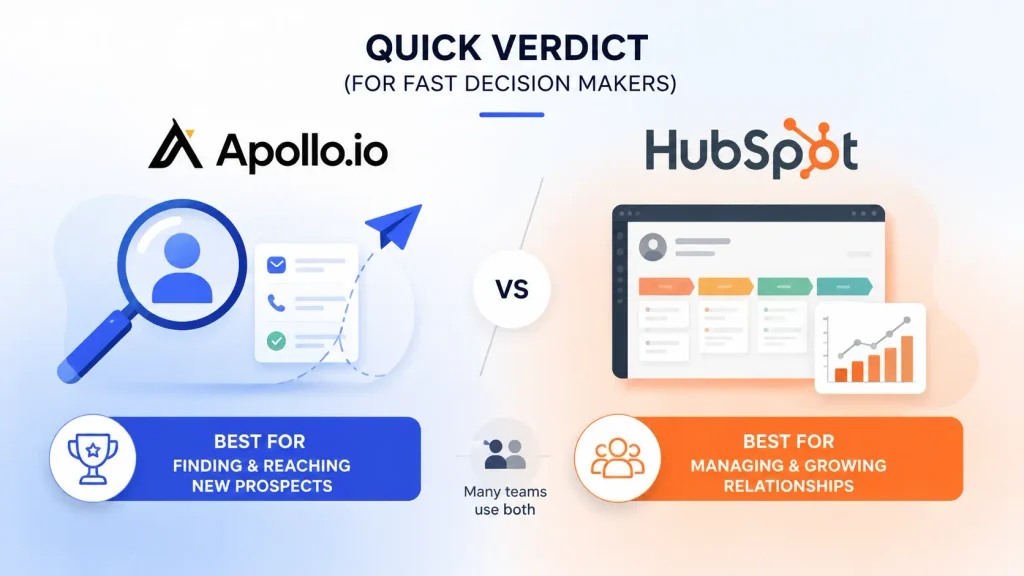
Best overall for outbound prospecting: Apollo.io, thanks to a built-in contact database plus sequencing in one tool.
Best overall for pipeline and reporting: HubSpot, since it’s a real CRM your whole revenue team can share.
Best for individuals or solo founders: Apollo.io. Its Basic plan gets you real automation for less than HubSpot’s Professional tier.
Best for growing teams: HubSpot. Seat-based pricing is more predictable than Apollo.io’s credit system once you scale past a few reps.
The short version: if your bottleneck is finding people to talk to, choose Apollo.io. If your bottleneck is managing the people you’re already talking to, choose HubSpot. Many teams eventually run both.
Apollo.io vs HubSpot: What’s the Real Difference?
Apollo.io is a sales intelligence and outbound engagement platform. It gives you a database of contacts, enrichment data, and the sequencing tools to email, call, and message them, all from one login.
HubSpot is built around its free CRM. Sales Hub adds deal tracking, meeting scheduling, and automation on top, but it doesn’t come with a prospecting database. It’s designed to be your system of record, not your list-building tool.
Neither is trying to be the other. That’s the part most comparisons skip.
Feature Comparison That Actually Matters
Prospecting and Data Enrichment
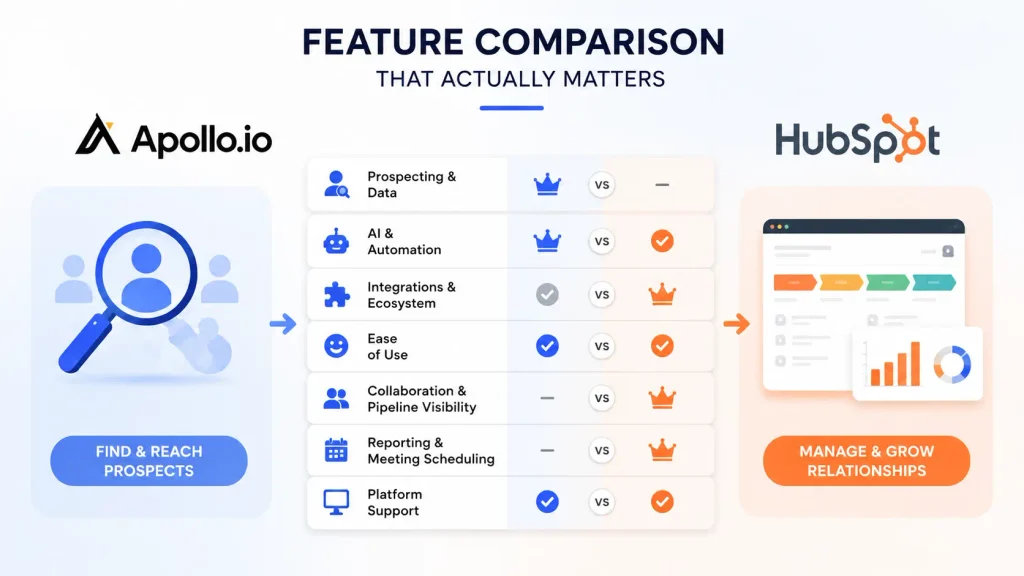
Apollo.io wins here by a wide margin. It ships with a database of 200M+ contacts and enriches records with 200+ data points, including verified emails and direct-dial numbers. HubSpot has no native equivalent. If you need to build cold outbound lists, Apollo.io is doing a job HubSpot was never built for.
AI and Automation Capabilities
Apollo.io again. Category scoring from G2 users puts Apollo.io well ahead on autonomous task execution and workflow automation. HubSpot’s automation exists, but it’s gated behind the Professional tier and leans more toward nurture sequences than outbound cadences.
Integrations and Ecosystem
This one’s closer. HubSpot has the larger marketplace at 1,500+ apps, but G2 reviewers flag cross-system integration friction as a real drawback. Apollo.io integrates natively into both Salesforce and HubSpot itself, since it’s often used as a feeder tool into a CRM rather than a replacement for one.
Ease of Use
Slight edge to Apollo.io based on G2 ease-of-use scores, though both platforms get generally positive marks. HubSpot users note the experience gets more complex as you add more Hubs.
Collaboration and Pipeline Visibility
HubSpot wins clearly. Shared deal records, pipeline stages, and cross-team visibility are the point of a CRM. Apollo.io’s collaboration features are built around outbound activity, not deal management.
Reporting and Meeting Scheduling
HubSpot. Native calendar sync and stakeholder-facing dashboards are a standout, and G2 category data backs this up for meeting scheduling specifically.
Platform Support
A tie. Both work well across web and desktop, and neither has a mobile experience differentiated enough to matter for this decision.
Pricing Breakdown (Hidden Costs Included)
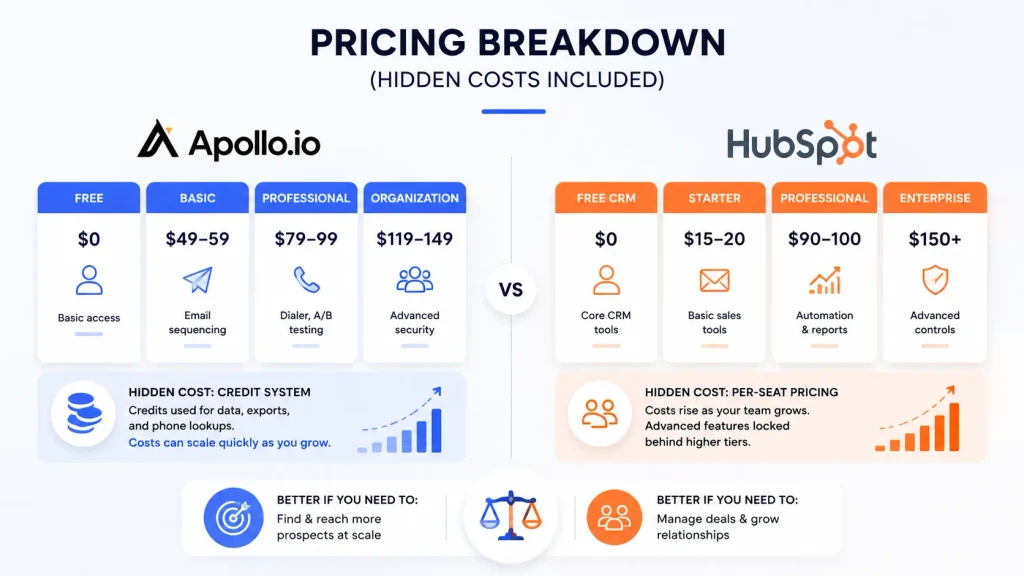
Apollo.io Pricing: What You Really Get?
This comparison uses live pricing pulled directly from apollo.io/pricing, checked this month.
| Plan | Price (per user/month, annual) | Monthly billing | What’s included? |
|---|---|---|---|
| Free | $0 | $0 | 900 credits/year, 2 sequences, basic filters |
| Basic | $49 | ~$59 | 30,000 credits/year, unlimited sequences, CRM integrations |
| Professional | $79 | ~$99 | 48,000 credits/year, US Power and Parallel Dialer, automated workflows, AI research |
| Organization | $119 (minimum 3 users) | ~$149 | 72,000 credits/year, international dialer, SSO, advanced security |
The seat price is the easy part. Apollo.io’s real cost driver is its shared credit pool. Data reveals, exports, and mobile-number lookups all draw from the same bucket, and multiple independent reports describe 10-person teams paying $600–$2,500/month against a $490–$990 sticker price.
HubSpot Pricing: What You Really Get
This comparison uses live pricing pulled directly from hubspot.com/pricing/sales, checked this month.
| Plan | Price (per seat, annual) | Monthly billing | What’s included? |
|---|---|---|---|
| Free | $0 | $0 | Free for up to 2 users, no card required |
| Starter | $15/seat | $20/seat | Core CRM plus basic sales tools, 500 HubSpot Credits |
| Professional | $90/seat | $100/seat | Sequences, forecasting, real automation, 3,000 HubSpot Credits. +$1,500 one-time onboarding fee, mandatory |
| Enterprise | $150/seat | $150/seat | Advanced permissions, custom objects, deal journey analytics, 5,000 HubSpot Credits. +$3,500 one-time onboarding fee, mandatory |
HubSpot’s pricing has two traps worth knowing before you buy. First, since its 2024 restructure, HubSpot splits users into Core Seats (Starter) and Sales Seats (Professional/Enterprise), and teams frequently under-provision one or the other. Second, the automation most sales teams actually want lives in Professional, not Starter, and Professional comes with a mandatory onboarding fee that isn’t shown in the headline price. Quoting and CPQ sit in a separate product, Revenue Hub, and aren’t included at any Sales Hub tier.
Which Tool Offers Better Value?
Outbound-heavy teams get more per dollar from Apollo.io. Teams managing an existing pipeline of inbound leads get more from HubSpot, especially once you factor in the shared CRM and reporting that a growing team actually needs.
Real User Experience (Pros and Cons)
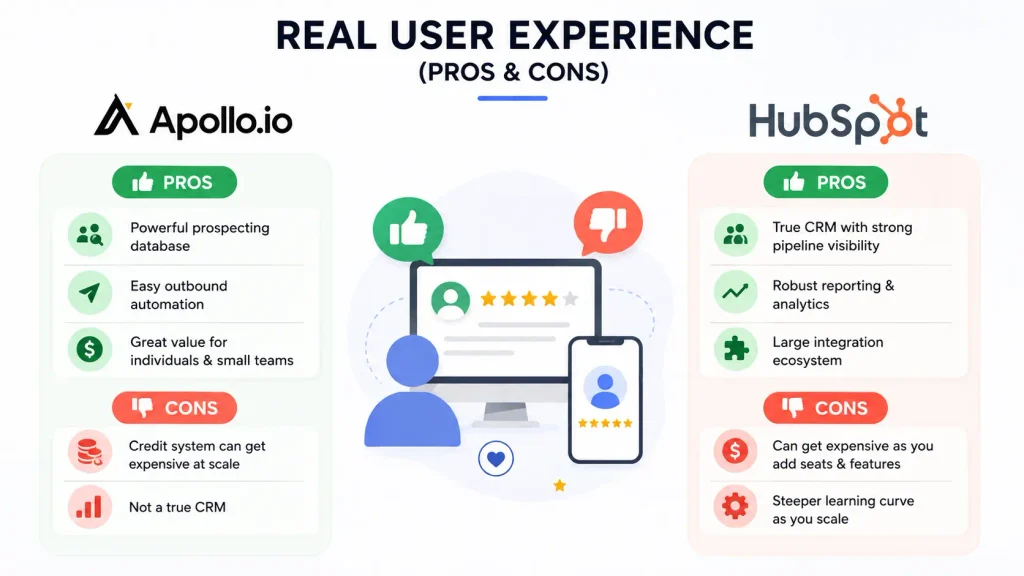
Apollo.io Pros and Cons
Pros:
- All-in-one workflow: find, verify, and sequence contacts without switching tools
- Strong list-building precision using intent and technographic filters
- Support response times reviewers rate above HubSpot’s
Cons:
- Data accuracy varies; some campaigns report bounce rates as high as 19–35%
- Credit system can burn through budget faster than the sticker price suggests
- Interface can feel overwhelming for first-time users, per Capterra reviews
HubSpot Pros and Cons
Pros:
- Free CRM is a genuinely usable on-ramp, not just a trial
- Meeting scheduling and calendar sync are best-in-class
- Reporting and dashboards are readable by non-sales stakeholders
Cons:
- Costs scale quickly once you add seats and Professional-tier automation
- Onboarding fees are mandatory at Professional and Enterprise, not optional
- Cross-system integrations can be more friction-prone than advertised
- Quoting and CPQ aren’t included at any tier; it’s a separate paid add-on
When You Should Choose Apollo.io?
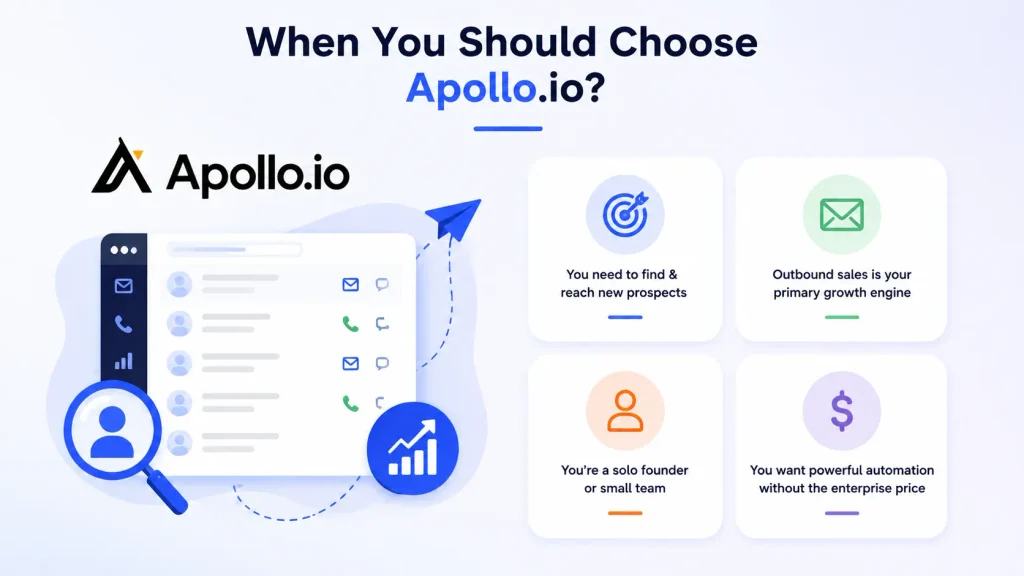
- You’re running high-volume cold outbound and need a contact database, not just a sequencer.
- You’re a solo founder or small SDR team testing a new market segment.
- You want multi-channel cadences (email, call, LinkedIn) run from one tool.
- Budget is tight and you need real prospecting data without enterprise pricing.
- You already use HubSpot or Salesforce as your CRM and just need a data and outreach layer on top.
- Your team is disciplined about monitoring credit usage to avoid overage costs.
When You Should Choose HubSpot?
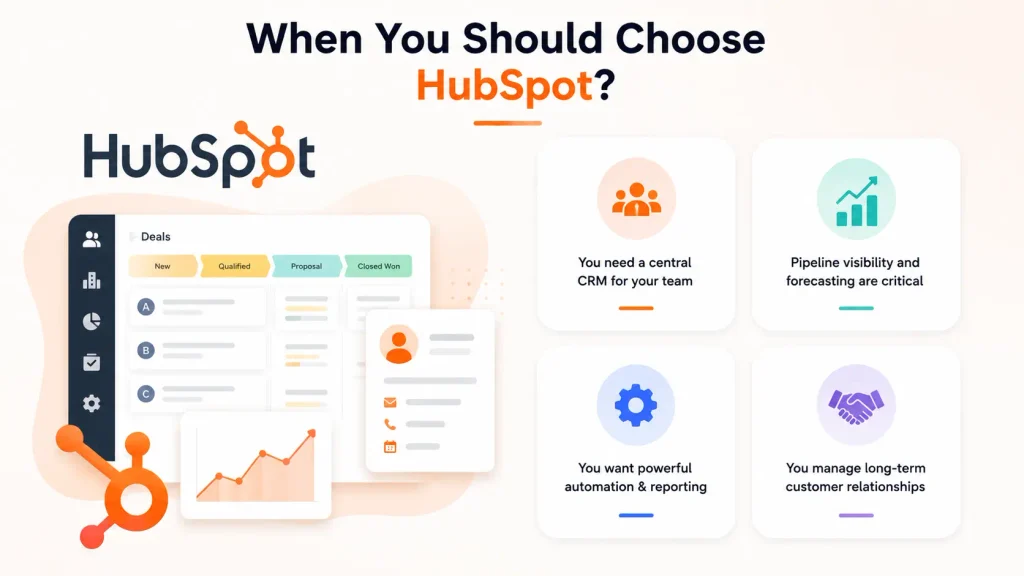
- You need one system of record shared across sales, marketing, and service.
- Inbound leads, not cold outbound, drive most of your pipeline.
- You want manager-facing reporting and forecasting without building it yourself.
- You’re scaling a team and need predictable per-seat costs instead of usage-based credits.
- Meeting scheduling tied directly to deal records matters to your workflow.
- You plan to eventually add Marketing Hub or Service Hub and want everything on one data layer.
When Neither Tool Is the Right Choice?
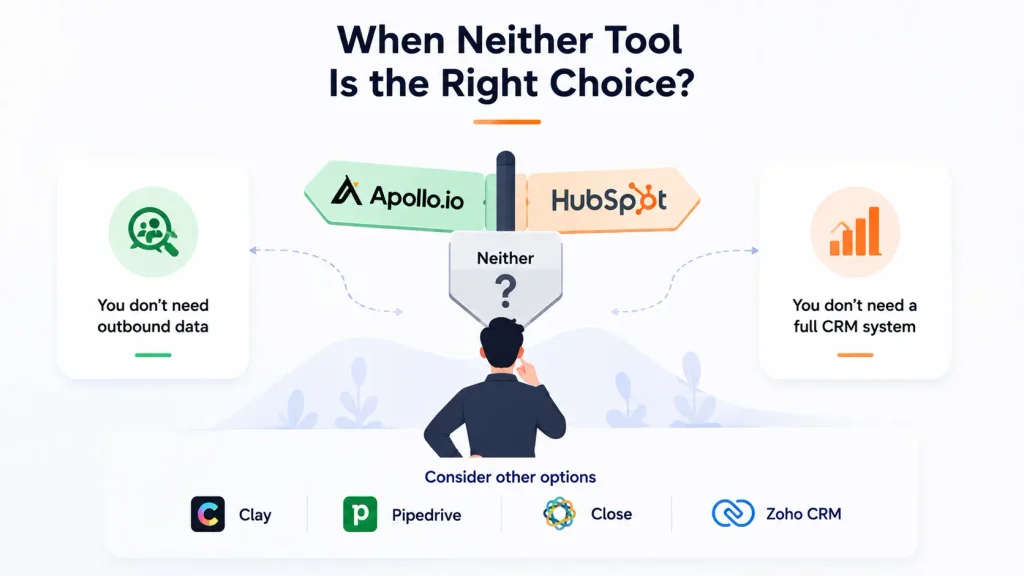
Skip both if you need native CPQ or quoting. Neither platform includes it without a separate add-on. Skip both if your priority is deep account-based intelligence rather than contact volume; dedicated account-based platforms are built for that specifically. If you’re extremely budget-constrained, both tools introduce cost variables (credits or onboarding fees) that can outgrow a bare-bones budget quickly.
Hidden Limitations Most Blogs Ignore
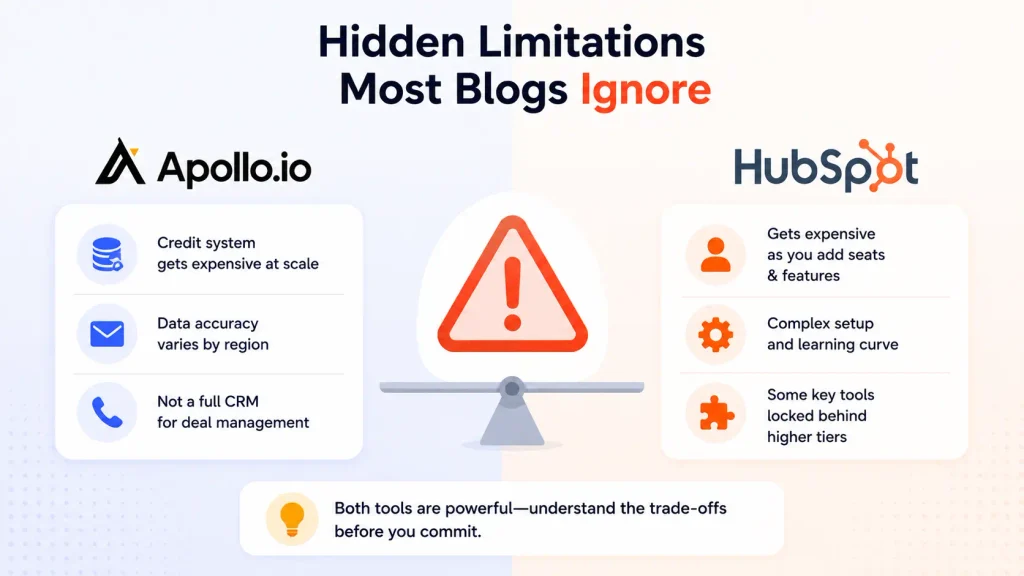
Apollo.io’s credit system is the biggest hidden cost, and it’s easy to underestimate until your first overage bill. HubSpot’s seat-type split (Core vs. Sales) causes real confusion during setup, and the onboarding fees at Professional and Enterprise change your year-one cost more than the monthly price suggests. Both platforms also have data-accuracy complaints in their prospecting-adjacent features, so neither is a perfect source of truth on its own.
Frequently Asked Questions
Can you use Apollo.io and HubSpot together?
Yes. It’s a common setup: Apollo.io handles prospecting and outreach, then syncs contacts and activity into HubSpot as the CRM of record.
Is Apollo.io cheaper than HubSpot?
At the entry tier, generally yes. Apollo.io’s Basic plan costs less than HubSpot’s Professional tier and includes more automation than HubSpot’s Starter plan. HubSpot’s free CRM is more generous than Apollo.io’s free plan for basic contact management, though.
Does HubSpot have a built-in contact database like Apollo.io?
No. HubSpot manages the contacts you add or import; it doesn’t provide a searchable database of new prospects the way Apollo.io does.
What’s the difference between HubSpot Core Seats and Sales Seats?
Core Seats give general CRM edit access. Sales Seats unlock sales-specific features like sequences and forecasting. Most sales reps need a Sales Seat, not just a Core Seat.
Is Apollo.io’s free plan good enough for a small team?
It’s usable for testing the platform, but the Gmail-only sending restriction and low credit allowance mean most teams outgrow it within the first few weeks of real prospecting.
Does either tool include quoting or CPQ?
No. Both require a separate paid add-on or a third-party tool for quoting and CPQ functionality.
Final Verdict: Which One Should You Choose?
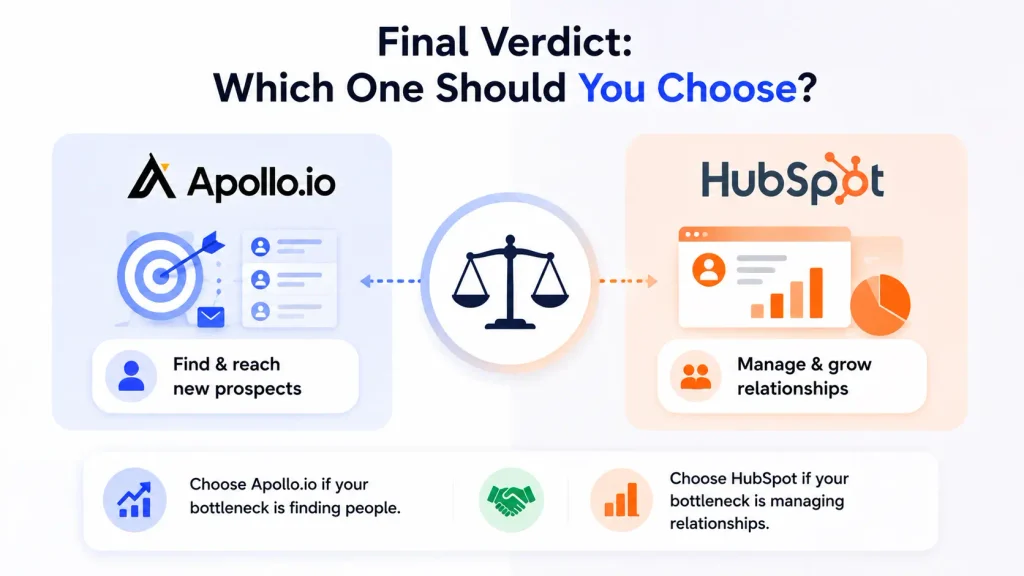
Best overall: Apollo.io if your bottleneck is finding prospects. HubSpot if your bottleneck is managing them.
Best for individuals: Apollo.io, for cheaper access to real automation.
Best for teams: HubSpot, for predictable pricing and shared reporting.
Decision framework: If you’re outbound-heavy, a small team, and budget-conscious, choose Apollo.io. If you’re managing inbound pipeline, need one shared CRM, and are scaling a team, choose HubSpot.



[…] Must Read: Apollo.io vs HubSpot: Which One Actually Fits Your Sales Team? […]