
If you are choosing AI tools for a team, classroom, publishing workflow, or content operation, you have probably encountered AI content detectors that claim to estimate whether a piece of writing was generated by artificial intelligence. These tools can be useful, but their results should be interpreted carefully. A detection score is an analytical signal, not definitive proof of who wrote a document.
AI content detection is fundamentally a probability-based process. A detector examines linguistic and statistical characteristics such as word predictability, sentence structure, vocabulary patterns, and stylistic consistency, then estimates how closely the text resembles patterns associated with AI-generated writing. That is very different from directly observing how the document was created.
For educators, businesses, publishers, and content teams, understanding how AI detectors work—and where they can fail—helps prevent costly decisions based on an isolated score. The most reliable workflow treats detection as one input alongside authorship context, drafts, fact-checking, editorial review, and other evidence rather than as an automatic pass-or-fail test.
Editorial note: Turnitin0 is an independent third-party service and is not affiliated with or endorsed by Turnitin, LLC. Turnitin and Turnitin0 are separate websites and services. Readers should verify the provider and service they are using before submitting documents or making a purchase.
How Detectors Work?
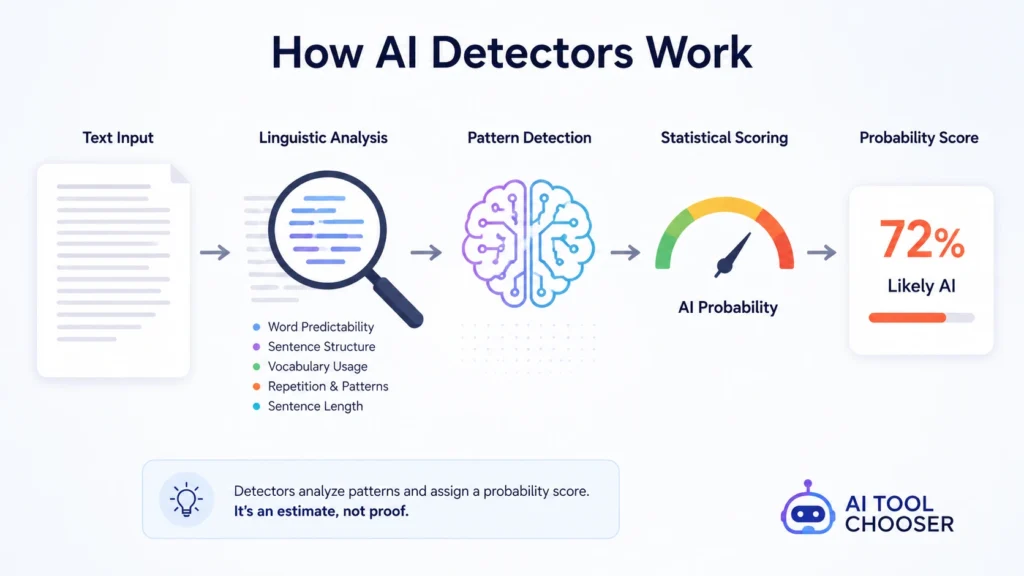
AI content detectors generally analyze patterns across a piece of text. Depending on the system, those patterns can include word predictability, sentence-length variation, vocabulary distribution, repetition, punctuation, sentence structure, and other statistical characteristics that may be associated with language-model output.
One commonly discussed concept is predictability. Language models generate text by selecting likely sequences of words, so highly predictable wording can sometimes resemble machine-generated prose. Some detectors also examine variation in sentence structure and vocabulary to estimate how uniform or distinctive a passage is.
These signals can be useful for screening, but none is unique to AI-generated writing. Human authors also produce predictable language, particularly when they follow an established style guide, write technical material, or work from a standardized template.
A human writer who uses clear vocabulary, consistent sentence structures, and organized paragraphs can therefore produce text that looks statistically similar to AI-generated writing. Conversely, an AI-generated draft that has been substantially edited, rewritten, or personalized may become harder for a detector to identify.
This is why an AI detector percentage should not be interpreted as a factual statement such as “this article was written by AI.” It is better understood as an estimate based on observable characteristics of the text, with a level of uncertainty that depends on the detector and the material being analyzed.
Detection technology is also evolving. AI writing models, editing tools, and detection systems are updated regularly, so performance can change over time. A detector that works well on one type of content may perform differently on another language, document length, writing style, or generation model.
The Accuracy Problem
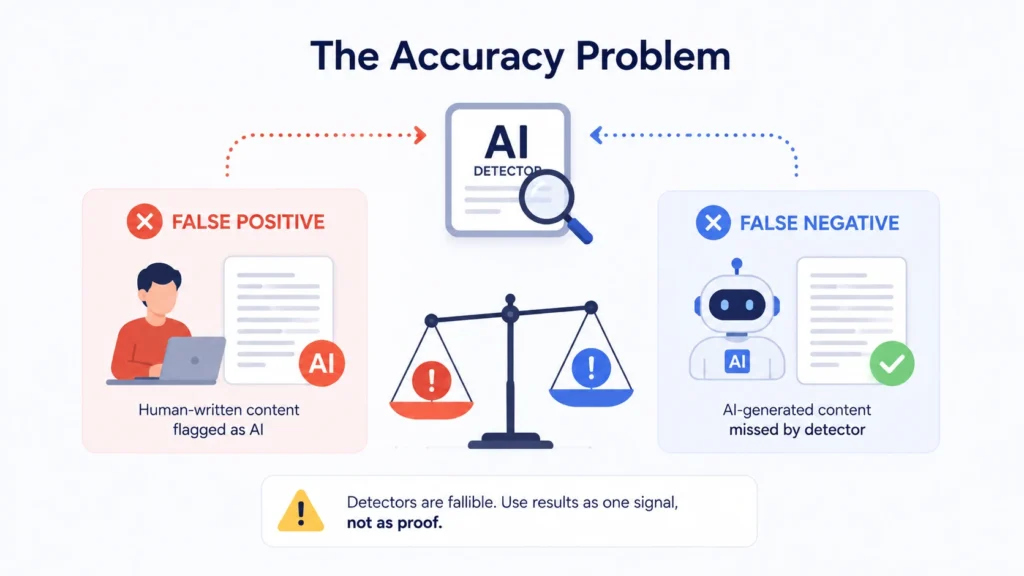
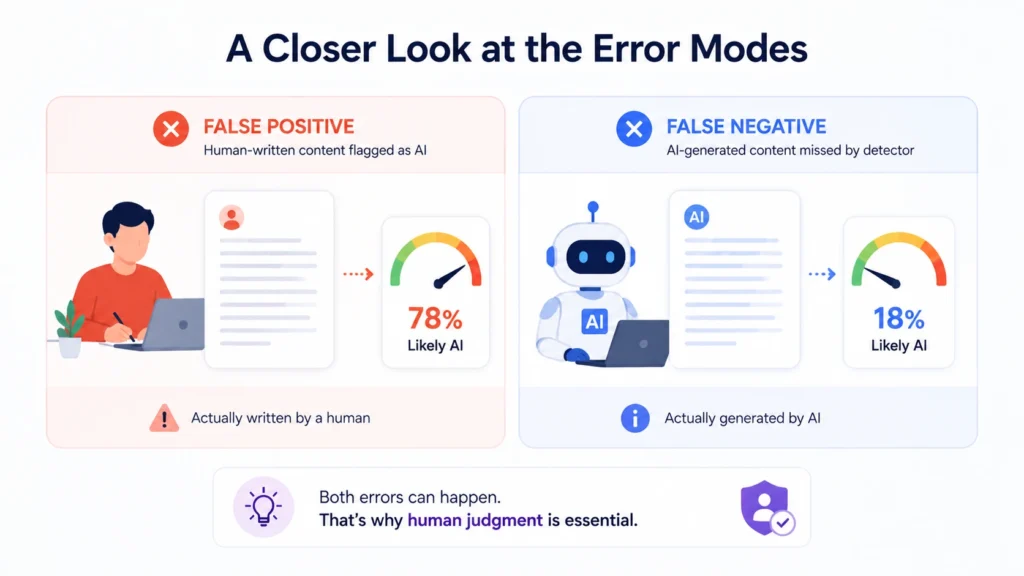
Accuracy is one of the biggest challenges when evaluating AI content detection tools. A detector can make a false negative by missing AI-generated text, or a false positive by classifying human-written text as AI-generated. Both errors matter, but false positives can be especially serious when a score influences an academic, employment, publishing, or business decision.
Independent research and publicly available benchmark testing have shown that AI detectors can incorrectly classify human-written material as AI-generated. Public research, including published benchmark research and analysis, illustrates why detector results need to be interpreted in context rather than treated as proof of authorship.
The challenge is that there is no single “human writing style.” Academic papers, technical documentation, business reports, carefully edited marketing copy, and writing produced by people using English as a second language can all contain the structured patterns that some detection systems associate with language-model output.
A detector’s performance can also vary according to the length of the document, language, subject matter, author’s writing style, degree of editing, whether generated text has been paraphrased, the AI model involved, and the detection methodology used by the vendor. A result from a short paragraph should not automatically be treated the same way as a result from a long, independently verified document.
For this reason, a detection score should be treated as a signal that may warrant further review—not as conclusive evidence of authorship. The more significant the decision, the more important it is to consider additional evidence before reaching a conclusion.
- The length of the document
- The language being analyzed
- The subject matter
- The author’s writing style
- How heavily the content has been edited
- Whether AI-generated content has been paraphrased or substantially rewritten
- The particular AI model used to create the text
- The detection model and methodology used by the vendor
When evaluating an AI detection tool, look beyond the headline accuracy percentage on the vendor’s website. Ask how that number was calculated, what data was tested, which AI models were included, and whether the testing conditions resemble the writing your organization actually handles.
Choosing Tools With Your Eyes Open
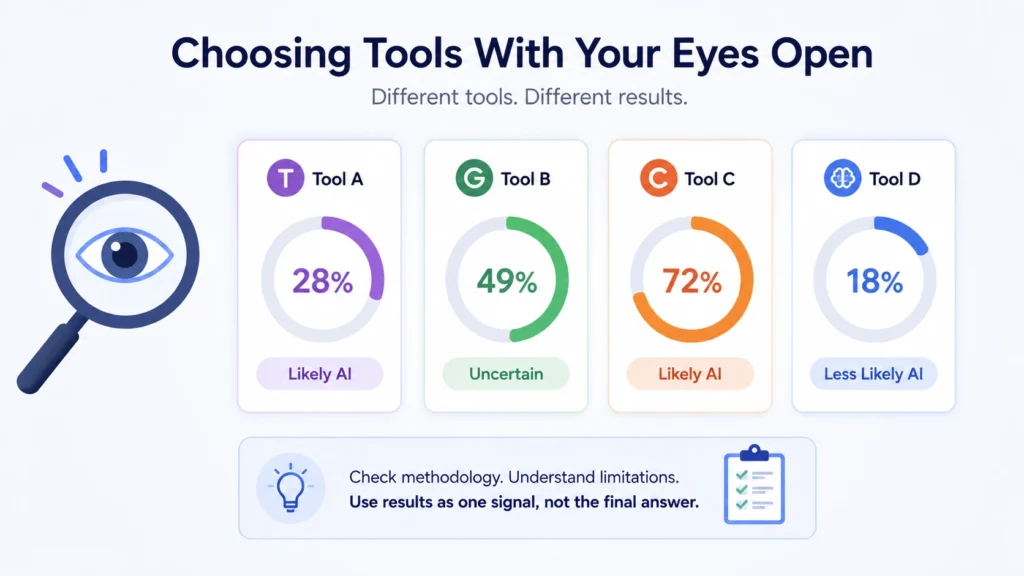
Start with a basic question: What is the false-positive rate on genuine human-written content? A detector can identify a large share of AI-generated samples and still create significant problems if it frequently flags authentic human writing. For many organizations, understanding the cost of that error is more important than focusing on a single overall accuracy figure.
You should also investigate whether the company explains its methodology. A transparent vendor should provide enough information to understand what was tested, how results were measured, what limitations apply, and whether the system has been evaluated independently. Claims that cannot be examined are difficult to use as a basis for high-stakes decisions.
Other useful questions include whether the tool has been independently tested, how it handles short documents, whether performance varies across languages, whether users can review disputed results, how confidence scores are explained, how frequently the model is updated, and what happens to uploaded documents and user data.
These questions matter because an AI detector can influence real decisions. In a classroom, a false positive could affect a student’s academic standing. In a business, it could cause legitimate work to be rejected. In publishing, it could create an unnecessary dispute with an author or contributor.
- Does the company publish independent testing or validation?
- How does the tool handle short documents?
- Does performance vary between different languages?
- Can users review or appeal questionable results?
- Does the company explain confidence scores and limitations?
- How frequently is the detection model updated?
- What happens to uploaded documents and user data?
Most importantly, detection does not answer broader questions about content quality. A detector cannot determine whether an article is accurate, useful, original, well researched, or aligned with a brand’s voice. Those questions still require human editorial judgment and, where necessary, independent fact-checking.
AI detector errors are not necessarily random. Certain legitimate types of human writing can be more likely to trigger detection systems because of the statistical characteristics of the language. Understanding these patterns makes it easier to interpret results and design a fair review process.
A Closer Look at the Error Modes
First, style regularisation. Professional writers often follow consistent sentence structures, predictable transitions, concise paragraphs, and standardized terminology. Consistency improves readability and brand quality, but it can also make writing statistically more predictable.
Second, template adherence. Legal summaries, academic papers, technical documentation, business reports, product descriptions, and other professional documents often follow predefined formats. A document can therefore look highly structured without being machine-generated.
Third, second-language writing. People who write in English as a second language may produce careful, grammatical, and highly structured prose. Some research has raised concerns that certain AI detection systems can behave differently when analyzing non-native English writing, making language background an important consideration when interpreting results.
Fourth, extensive editing. The opposite problem can occur with AI-generated material. Once a person rewrites an AI draft, changes sentence structures, adds personal experience, replaces generic wording, and introduces original research, the final text may become difficult for a detector to distinguish from human writing.
These examples show why a detection score requires context. The important question is not only how much AI-generated content a detector catches, but also how often it incorrectly labels authentic human writing and under what conditions those errors occur.
For organizations using these tools, measured false-positive performance on realistic human-written samples can be more useful than an impressive detection-rate claim on a marketing page. Testing the tool on your own content can reveal limitations that a general benchmark may not show.
When you compare AI content detection tools, a practical evaluation checklist can make the process more reliable. The objective is not to find a detector that promises certainty, but to understand how useful its results are for your particular workflow.
How to Evaluate a Detector Tool?
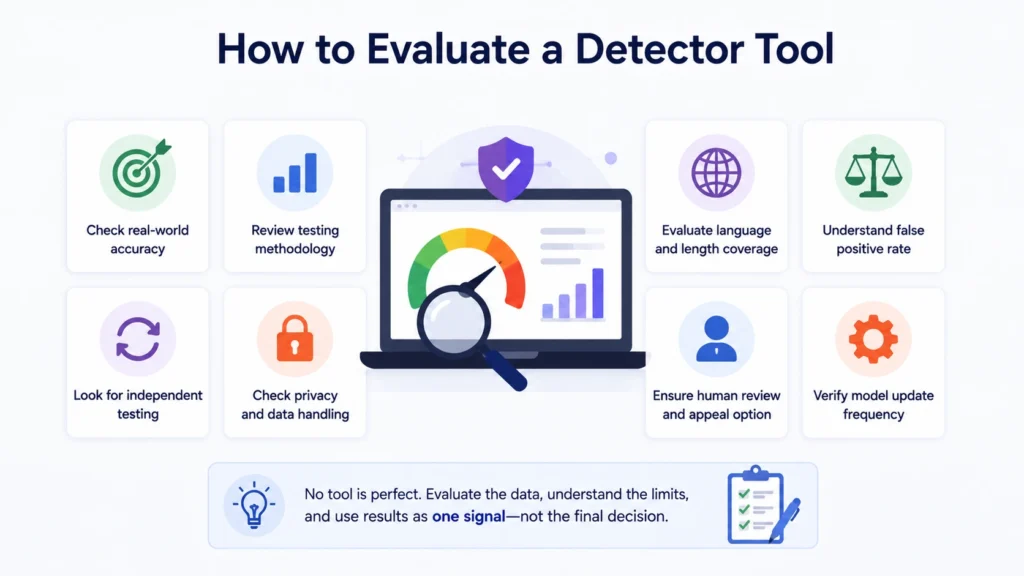
Before choosing a tool, test it with writing that closely matches your real use case. Include different authors, document lengths, writing styles, and, where relevant, second-language English writers. A detector that performs well on generic test samples may behave differently on your organization’s actual content.
- Test the detector using writing that closely matches your actual use case
- Include content from different writers, including second-language English writers where relevant
- Test short, medium, and long-form content instead of relying on one sample
- Check whether the vendor publishes methodology, benchmarks, and error information
- Look for independent evaluations rather than relying exclusively on vendor claims
- Find out whether the tool provides useful explanations or confidence information alongside its score
- Check whether there is a human review or appeal process for disputed results
- Consider the consequences of a false positive before using the detector to make decisions
- Test content that has been edited or substantially rewritten to understand how the tool responds
- Review the vendor’s privacy and data-retention policies before uploading confidential material
It is also useful to test short, medium, and long-form material rather than relying on one sample. Compare verified human-written content with AI-generated drafts and heavily edited AI-assisted content. This gives you a clearer picture of both false positives and false negatives.
Check whether the vendor publishes methodology, benchmarks, and error information. Look for independent evaluations where available, and determine whether the tool provides useful explanations or confidence information instead of presenting a score without context.
Finally, find out whether there is a human review or appeal process for disputed results. Review the vendor’s privacy and data-retention policies before uploading confidential material, especially when the documents contain unpublished work, customer information, student submissions, or internal business content.
Using Detection in a Real Workflow
It is often worth creating your own internal test set. A marketing team, for example, could collect verified human-written articles, AI-generated drafts, and edited AI-assisted pieces and run them through several detectors. Comparing the results can reveal which tools are most useful for the team’s actual needs.
This kind of evaluation is often more informative than comparing a few advertised accuracy percentages. No detector identifies every AI-generated passage, and no detector perfectly classifies every human-written document. Different systems have different strengths, weaknesses, and edge cases.
The most practical way to use AI detection is as part of a broader content-quality workflow. Detection works best when it supports other checks rather than replacing them.
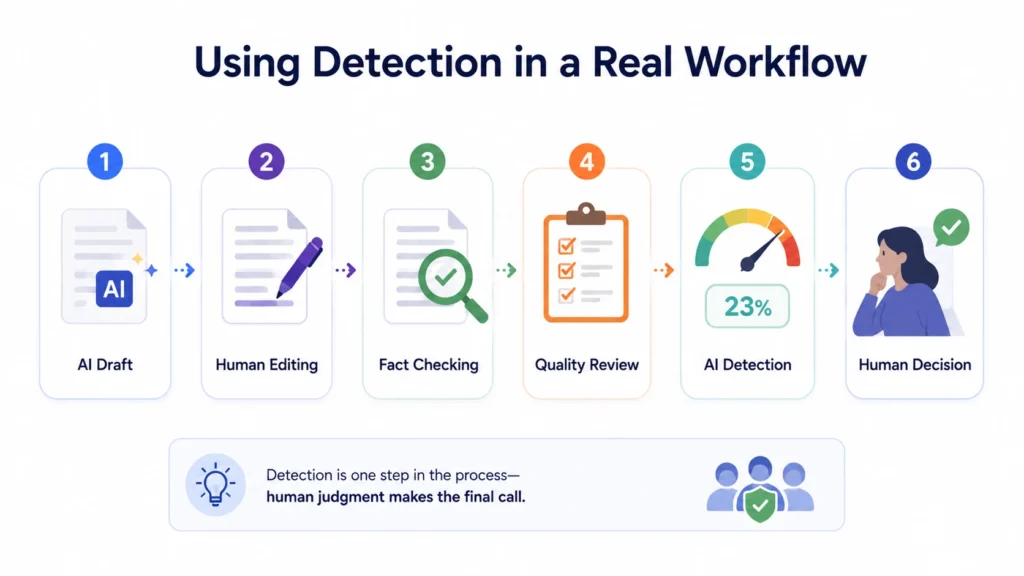
For example, a content team might use AI to help create an initial draft, have an editor verify facts and improve the writing, check the content against SEO and editorial requirements, and then use an AI detector as an additional review signal. The detector becomes one checkpoint in the process rather than the final authority. For users who want to compare options, an independent third-party AI detection service can be considered as one example of an external checking option, but its results should still be interpreted alongside human review and other evidence.
A simple workflow could look like this: AI-assisted draft → Human editing → Fact-checking → Quality review → Detection check → Human decision. The exact sequence can vary, but the principle is the same: important decisions should not depend on a single automated score.
If a document receives a high AI probability score, an editor can examine the writing more closely. Depending on the situation, they might compare it with previous work, review drafts and revision history, ask the author about the creation process, or request additional evidence before deciding what to do.
If the detector does not flag the content, the document should still go through normal editorial review. A low detection score does not prove that content is human-written, just as a high score does not prove that AI was used. Both outcomes need to be interpreted alongside the available context.
This distinction is especially important for organizations that want consistent content standards without creating unnecessary disputes. AI detection should support editorial judgment rather than replace it.
Practical Questions Before You Buy
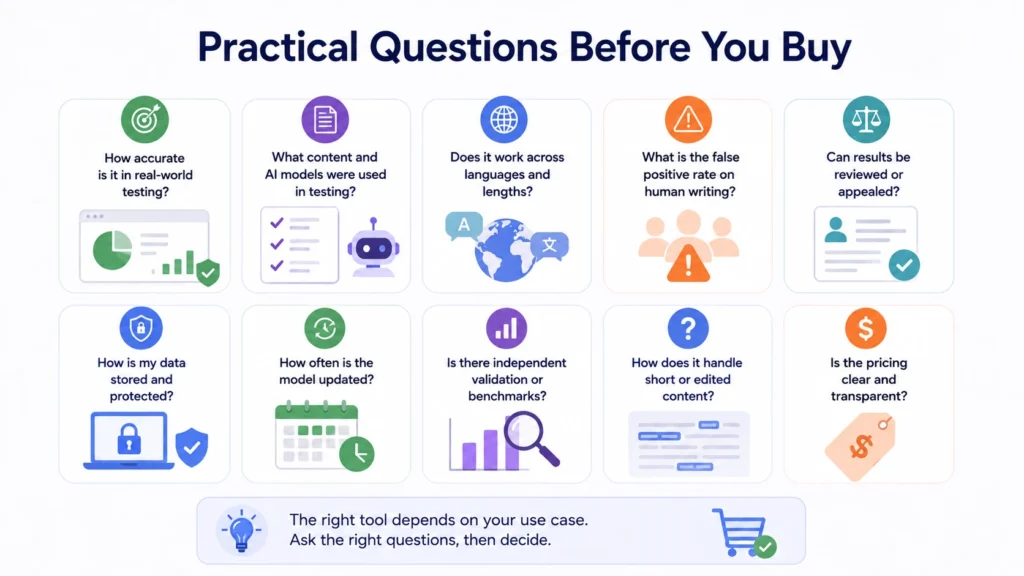
Before committing to an AI content detection tool, consider how it will actually be used and who could be affected by its results. The same level of uncertainty may be acceptable for a low-stakes editorial check but inappropriate for a decision that could affect a student’s grade, a contractor’s payment, or an employee’s reputation.
Ask whether a false positive could affect a student, employee, freelancer, contractor, client, or publisher. The higher the potential consequence, the more important it becomes to have a documented human review process and a way to challenge questionable results.
You should also consider whether the detector supports the languages and writing styles used by your organization. A tool designed primarily around English-language content may not perform equally well across other languages, regional varieties, or specialized forms of writing.
Data privacy is another important consideration. Before uploading internal documents, customer content, unpublished articles, or student work, determine how the provider stores and processes submitted text. Check whether uploaded content is retained, shared, or used to improve the company’s systems, and make sure those practices fit your organization’s requirements.
Useful questions include: Who reviews a disputed detection result? How long is uploaded content retained? Is customer content used for model training? Does the tool support the languages you need? Can detection results be audited later? And is the tool appropriate for the level of risk associated with the decision you want to make?
- Consider whether the tool’s results can be reviewed alongside other evidence before making a high-stakes decision.
- Who reviews a disputed detection result?
- How long is uploaded content retained?
- Is customer content used for model training or system improvement?
- Does the tool support the languages and writing styles your organization needs?
- How does the company handle false-positive complaints or disputed results?
- Can detection results be audited later?
- Is the tool appropriate for the level of risk associated with the decision?
The right solution depends heavily on the environment. A classroom may need a different approach from a marketing agency, publishing company, or internal communications team. A tool that is useful for screening drafts may not be appropriate as the sole basis for disciplinary or contractual decisions.
In many situations, the best answer is not simply purchasing a detector. It is establishing a clear policy for when AI assistance may be used, what should be disclosed, which types of content require additional review, and how questionable results should be handled.
The Durable Alternative
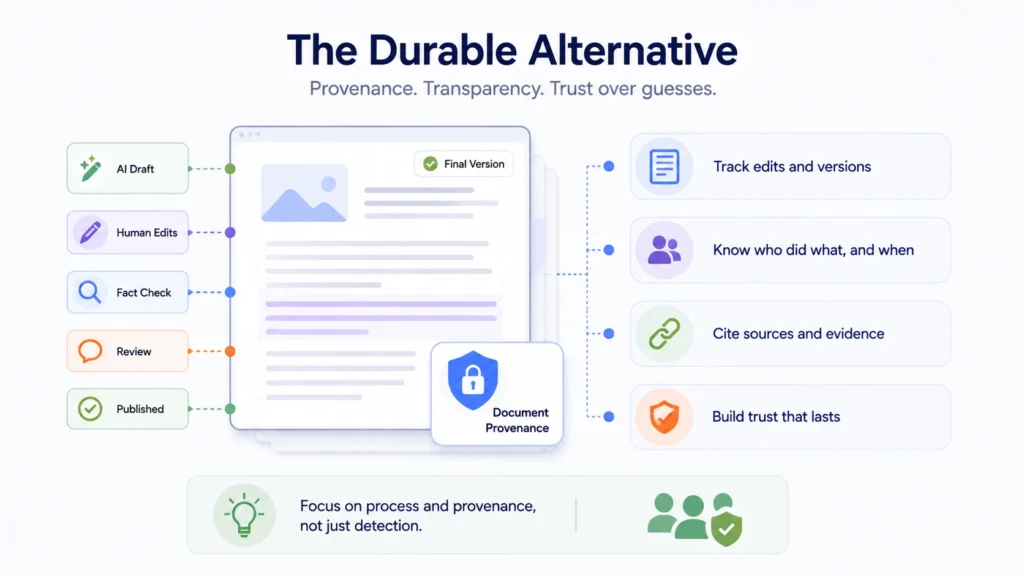
The longer-term approach to AI content verification may involve more than improving statistical detection. Instead of trying to determine authorship solely from finished text, organizations can also focus on provenance—documenting how a document was created, edited, and reviewed over time.
Draft histories, revision records, source materials, editorial comments, version control, and AI-use disclosures can provide context that a detector cannot recover from the final document alone. They can show how an article or assignment developed rather than asking a statistical model to infer its origin from the finished prose.
For example, an author who maintains research notes, citations, multiple drafts, revisions, and editorial feedback can demonstrate how a piece of content developed. That evidence can be especially useful when a detector produces an uncertain or disputed result.
This does not mean AI detection has no value. Detection tools can still provide an additional signal during content review, particularly when combined with clear policies and other quality checks. The stronger approach is to treat detection as one layer within a transparent verification process.
Organizations can therefore pair detection technology with AI-use policies that define when AI assistance is acceptable, what must be disclosed, which content requires additional review, and how disputes should be handled. This shifts the focus from finding a perfect detector to building a process that remains useful even as AI technology changes.
That approach is more sustainable than relying entirely on an ongoing race between AI generators and AI detectors. Statistical detection may continue to improve, but transparent documentation and human review remain valuable regardless of which model or detector is being used.
The Bottom Line
AI content detectors can be useful, but they should not be treated as definitive proof of whether a person or AI system created a piece of writing. Their scores are estimates based on patterns in the text, and those patterns can appear in both human-written and AI-generated content.
False positives, false negatives, differences in writing style, second-language writing, editing, document length, and changes in AI models can all affect detection performance. A responsible evaluation therefore looks at the tool’s limitations as carefully as its headline accuracy claims.
For teams, educators, publishers, and businesses, the safest approach is to use AI detection as one part of a broader review process. Test tools against your own content, ask vendors for transparent methodology and error information, consider the consequences of false positives, protect sensitive information, and keep a human involved in important decisions.
Ultimately, the goal should not be to find a magic percentage that proves who wrote something. The better goal is to create a content workflow that combines responsible AI use, strong editorial standards, transparency, provenance, and human judgment.